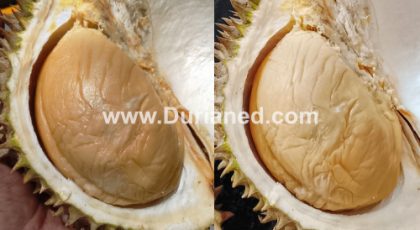
There are many unique taste that can come with durians. Among them, they are broadly grouped into 4 main types of tasting experience.
Sweet, bitter, floral aroma and alcoholic.
There are famous durians that embodies each of these tastes. For example, Johor Mas better known as 101 is a indulging sweet durian, Tawa D162 is a favourite among bitter durian lovers, ganja is famed for it’s floral finesse. Then we come to the durians that taste like alcoholic beverages you find in a bar.
Let me make a distinction here. There are a lot of durians that can have a hint of alcohol sensation when you bite into it. Musang king is probably the best example. Some musang kings from very old trees can have a gassy alcohol flavour in them. So is the indomitable capri which comes with hints of rum. But they are not classified as alcoholic durians.
Alcoholic durians really REALLY taste like shots of whisky, glasses of wine or a coupe of champagne.
They have a huge following of durian hunters who find the blend of durian and adult drinks irresistible.
But most of them are either too subtle in flavour for pleasure or too heavy for a ballroom party. And this is why the durian L13 has become one of the most unique and desirable durians around.
Nature bestowed this durian with a classy balance of durian and cognac. Enough flavour to give you a kick, yet not too intense to leave you drunk.
It’s under the species Durio lowianus. This is different from the common commercial durians like musang king and black thorn under the species Durio Zibethinus.
If we want to zoom in more, L13 is actually a variant of a cluster of durians grouped under the red flower name. In Malay, it’s bunga merah. And hong hua (红花) in Chinese. They are named as such because the flowers of these durian trees are red and pink. Regular durian trees have white flowers. And almost all of these red flower durians embody varying degrees of alcoholic flavour and sensation.
If you learned something new from this article, come follow me on FB
This L13 variant was first grafted as a typical red flower tree in a farm located in Negeri Sembilan. And when the owner discovered how special the durians turned out to be, he grafted more of them. Eventually enough to be eligible for registering with MARDI.
The name L13 is supposedly a reference to the famous cognac Louix XIII due to what the taste reminds the owner of.
It was registered in 2022 and given the official number D225.
Features of L13 durian
The size of L13 bunga merah is typically around 1kg give or take. The size of adult fruits are amusingly consistent. It should fit nicely right into an adult’s hand.
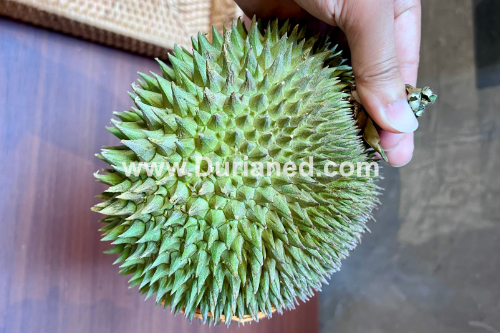
The rounded husk is mostly in a homogenous bright green. This is sort of a signature characteristic of Durio lowianus. I won’t be surprised to find it as a design trademark at the intellectual IP office.
The thorns are slim, somewhat long and solid that is consistent throughout the circular shape of the durian. It is not as slim as those found on tian song which also has slim spikes, but not as fat as those found on taukeh either.
The bottom navel is indented resembling that of D24.
This is a durian that can easily creak open naturally from the bottom navel. Which is why if you find it anywhere outside the farm of origin, the bottom will most probably be tightly secured with rubber bands to prevent and delay it from opening by itself.
Opening this durian is a breeze. Because of the thin rind, as long as you can find a good grip from digging into the navel indent, you will most likely be able to pull the husk apart with your bare hands.
As you secure a vice grip on it and open the durian, you will be slapped in the face with the strong fumes of cognac. At this point, you might be stunned at what you are handling here. Relax and don’t be fazed. Because the beauty to behold will be just moments away.
The fruitlets are bright golden yellow. So get your sunglasses ready if you have sensitive eyes.
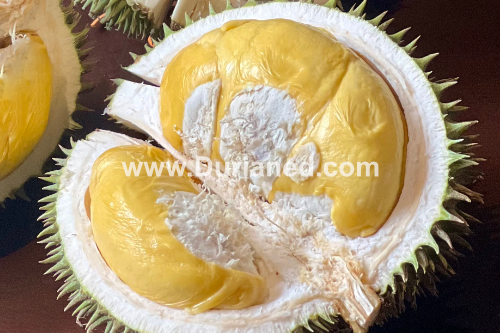
Like the crown jewels put on display in a national museum, this can be a majestic sight to witness. Shimmering, shining and glowing right in front of you.
Allured by the seductive aroma, by now you should be beyond tempted to stuff the fruitlets into your mouth.
The first time I had L13, I was totally unprepared for the experience even though I was warned beforehand. I took a big bite and the gas shot up my nose triggering a sensation like gulping down a mouthful of cola too quickly.
Now I give it much more respect. Respect that it thoroughly commands.
It taste like hard liqueur. I judge it to be cognac. Some kakis compare it to whisky. Some say it’s sake, soju, vodka, etc. There are also those who swear by their mother’s name that it’s bailey’s. So your mileage may vary depending on the mood of your tastebuds.
A friend having a first encounter with it shouted “cempedak durian” after a few bites. This is a local term referring to durian that embodies a hard liqueur taste profile.
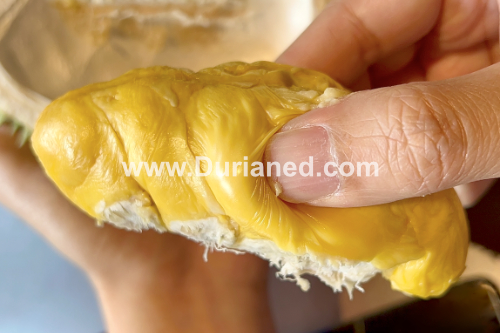
I’ve also witnessed a few people who had it the first time laughing uncontrollably in amazement at the taste after the first bite. It’s as if they were momentarily transported to the astral plane. I won’t be surprise if you react the same way too.
The flesh also triggers a sensation that comes with fresh ripe fruit. The durian flavour is mild accompanied by a subtle sweetness. Even if it’s supposed to be strong, it will be blanketed over by the aroma.
The power is in the aromatic alcoholic gas.
I’ve never tried taking a breathalyzer test after consuming L13. But as a warning, I have felt a little light-headed before after a few seeds. My friends experienced varying degrees of being high. So please practice caution with your activities after feasting on this durian.
Don’t operate heavy machinery, pilots should check your flying schedule, and married men should bring the receipts home in case the wife asks about your suspicious breath.
L13 durian harvest season
L13 is a main season durian. It generally enters the market during June to July.
But knowing when it drops during the season is really secondary because it has become a very in-demand durian with low supply.
Even if you are willing to pay 10 times the market price, you might not be able to secure one for yourself.
This is not just about the money. It’s about being able to try this rare durian at it’s peak quality. And many hardcore durianers vie for it competitively with methods that takes no prisoners.
A reason for this low supply is that there are not a lot of trees of this cultivar. To add to that, it is a tree that does not produce a great harvest.
When the fruiting season starts, the trees will be engulfed with red flowers. But not many of these flowers turn into fruits. Most likely due to challenges in pollination.
The fragile flowers are also very vulnerable to bad weather like thunderstorms. So even though the trees can signal a bountiful harvest from the blooming of red flowers, the amount of durians that actually come into fruition is often low in volume.
The implication is that if you ever run into it from some freak stroke of luck, or that you somehow ran into someone who is able to procure it for you, then I’d say just grab the opportunity and run. Because this window might never open for you again.
Read Next